Add your promotional text...
Overtime in Airline Catering
Blog post descriptPlanning Problem, Demand Pressure, or Commercial Decision?ion.
AIRLINE CATERINGOVERTIME
Andrew Caines
5/19/20263 min read
Overtime is one of the most visible labour cost pressures in airline catering.
For General Managers and Directors, it is also one of the most important signals to understand.
It affects payroll cost, productivity, service reliability, employee behaviour, and margin performance. But overtime is often explained too simply:
“We had more flights.”
“We had sickness.”
“We were short-staffed.”
“The airline changed the schedule.”
“We had no choice.”
Sometimes, those explanations are valid.
Airline catering is a variable environment. Flight schedules change, passenger numbers move, airlines make late requests, and disruption happens. There are also legitimate spikes in absenteeism during periods of Covid, flu, or seasonal illness.
So the objective should not be to eliminate overtime completely.
The real leadership question is:
Is overtime being caused by genuine operational pressure, weak planning, poor productivity, or a deliberate cost decision?
That distinction matters because each cause requires a different response.
Overtime is not always bad
Not all overtime is a problem.
Some overtime is planned, justified, and commercially sensible. It may be linked to peak demand, temporary vacancies, sickness cover, airline disruption, seasonal volume, or short-term project work.
This is especially relevant in markets such as the Middle East, where employment packages often include housing, transport, visas, medical cover, uniforms, and other fixed costs.
In that context, hiring additional full-time employees is not always cheaper than using controlled overtime.
If demand pressure is temporary, overtime may be the better commercial decision.
But this only works when overtime is visible, measured, and controlled.
There is a major difference between overtime used as a deliberate labour strategy and overtime used because the operation is constantly firefighting.
One is a decision.
The other is a symptom.
When overtime becomes a warning sign
Overtime becomes dangerous when it is uncontrolled, repeated, or accepted as normal.
In many catering operations, overtime is not caused only by demand. It is often created by weaknesses in the operating model:
Poor labour planning.
Weak roster discipline.
Late schedule adjustments.
Unplanned vacation gaps.
Low productivity visibility.
Limited cross-training.
Supervisors solving every problem with extra hours.
When this happens, overtime becomes the buffer that hides planning weaknesses.
The operation may still deliver the flights, but the cost of delivery increases. Over time, this becomes margin leakage.
That is why senior leaders should not only ask:
“How much overtime did we use?”
They should ask:
“Why was overtime needed in the first place?”
Sickness and absence must be built into the plan
Absenteeism is a real operational issue.
Covid, flu, and seasonal sickness can create sudden labour shortages. These situations are not always avoidable and should not automatically be treated as poor management.
However, sickness spikes are not completely unpredictable.
Most operations know when absence risk increases, which departments are most exposed, and which roles are hardest to cover.
A strong catering operation does not assume perfect attendance.
It plans for realistic absence.
That means having cross-trained employees, temporary labour options, clear redeployment rules, and department-level absence tracking.
Without this discipline, legitimate sickness quickly turns into uncontrolled overtime.
Overtime can influence employee behaviour
There is another point senior leaders should not ignore.
In some markets, particularly where basic wages are low, overtime can be financially attractive to employees. For many workers, overtime is an important part of their income.
This creates a management challenge.
If overtime is poorly controlled, the system may unintentionally reward longer hours instead of productive hours.
In some cases, employees may slow productivity, extend tasks, or become resistant to changes that reduce overtime opportunities.
This does not mean overtime behaviour is always negative. Many employees genuinely support the operation during pressure periods.
But leadership must recognise the incentive structure.
If the operation rewards hours more than output, behaviour will follow the reward.
That is why overtime control needs data, standards, and productivity tracking — not just supervisor judgement.
What leadership should track
Overtime reduction does not start with telling managers to “cut hours”.
That usually creates pressure without solving the root cause.
A better approach is to track five things consistently:
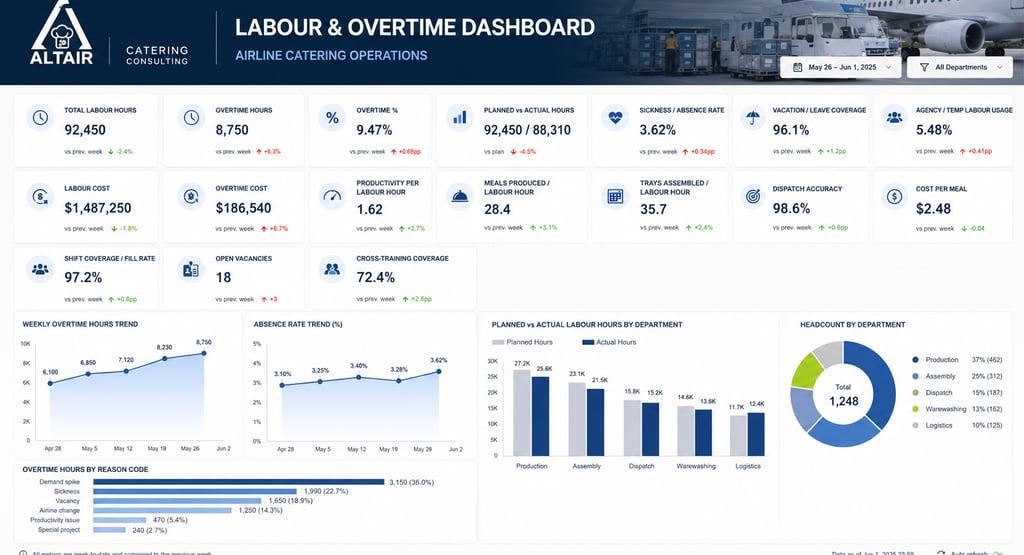
1. Planned hours versus actual hours
Where is the operation exceeding the labour plan, and why?
2. Overtime reason codes
Was it caused by demand, sickness, vacancy, poor planning, productivity, airline disruption, or special projects?
3. Productivity by department
How many meals, trays, flights, or tasks are completed per labour hour?
4. Repeat overtime patterns
Which departments, shifts, supervisors, or activities repeatedly generate overtime?
5. Full cost comparison
Is overtime actually cheaper than hiring additional employees once housing, transport, visas, medical cover, and other employment costs are considered?
This gives General Managers and Directors a clearer view.
They can separate justified overtime from avoidable overtime.
The leadership view
Overtime is not just a payroll issue.
It is a management signal.
It can show genuine demand pressure.
It can show sickness and absence risk.
It can show weak planning.
It can show low productivity.
It can show poor roster discipline.
It can also show a deliberate labour cost decision that may be commercially justified.
The key is knowing which one it is.
A catering unit that uses overtime intentionally, with clear controls and commercial logic, is different from one that depends on overtime because the planning system is weak.
For senior leaders, the real question is not:
“How do we eliminate overtime?”
It is:
“Is our overtime planned, justified, and commercially sensible — or is it hiding weaknesses in the way we manage the operation?”
That is the question worth asking in every airline catering operation.