Add your promotional text...
Profitability in airline catering comes from consistency, not heroic recovery
Profitability in airline catering is not achieved by reducing delays alone.
AIRLINE CATERING
4/28/20263 min read
Profitability in airline catering comes from consistency, not heroic recovery
Profitability in airline catering is not achieved by reducing delays alone.
It comes from operating with consistency.
Most catering operations focus heavily on two KPIs: food quality and OTP. Both are essential. Food quality protects the passenger experience. OTP protects the airline schedule.
But when OTP becomes the dominant measure of performance, managers often protect it at any cost.
· More overtime.
· More last-minute labor.
· More urgent fixes.
· More pressure on production and dispatch teams.
· More supervisors firefighting the same problems every day.
The delay is avoided, but the margin is damaged.
That is the part many operations do not measure clearly enough.
A catering unit can achieve OTP by spending more every day. That does not make the operation efficient, and it does not make the business more profitable.
For GMs and operational leaders, the real question is not only:
“Did we avoid the delay?”
It is:
“What did it cost us to avoid the delay?”
The secret to profitability is not heroic recovery. It is consistent execution.
OTP can hide operational inefficiency
A flight may depart on time. The client may be satisfied. The service may look controlled from the outside.
But inside the operation, the cost of achieving that OTP may be too high.
This is where profitability is often lost.
When the process is unstable, teams compensate with effort: extra labor, overtime, manual follow-up, last-minute substitutions, urgent maintenance interventions, and supervisors solving the same issues again and again.
That is not sustainable performance.
It is expensive recovery.
In these situations, OTP creates a dangerous illusion. The operation looks reliable because flights are leaving on time, but profitability is being used to protect the KPI.
A high OTP number is not enough if the business has to spend too much to achieve it.
Consistency changes the economics
When execution becomes stable and repeatable, the economics of the operation change.
The focus is no longer only delay reduction. The focus becomes daily control across planning, labor, waste, productivity, maintenance, and service reliability.
That is where margin is protected.
In a consistent operating model:
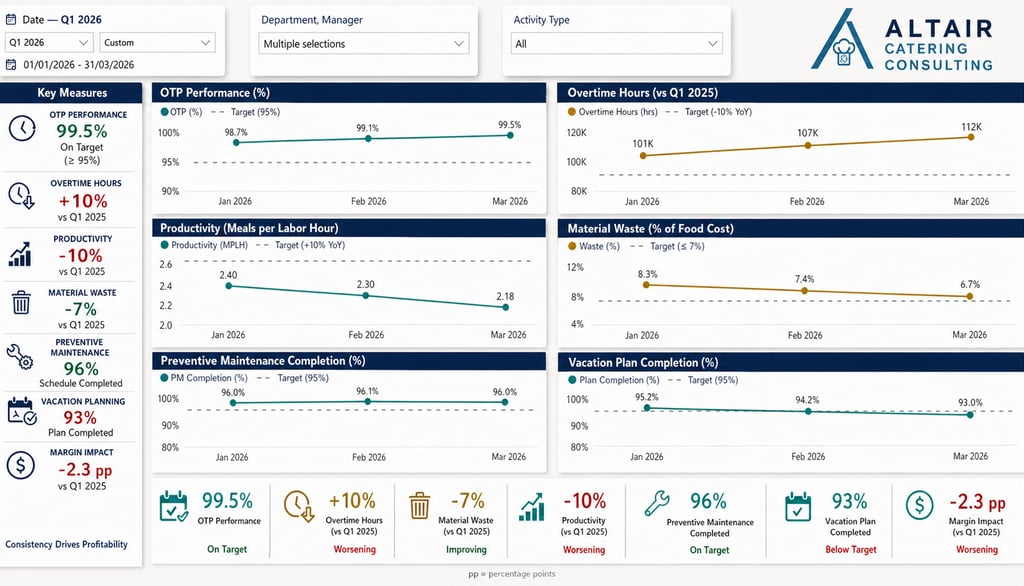
vacation planning is completed earlier and with more discipline
overtime is reduced because teams rely less on last-minute recovery
material waste goes down because planning, purchasing, and production are better aligned
productivity improves because teams spend less time correcting preventable issues
preventive maintenance becomes more reliable
OTP becomes sustainable rather than expensive
None of these improvements come from one heroic action.
They come from better daily control.
That is the difference between looking efficient and being profitable.
The hidden price of OTP
When OTP is achieved through constant overtime, is the operation really performing?
On paper, the flight is protected.
But inside the unit, the cost may be building every day.
Overtime becomes normal. Supervisors keep firefighting. Productivity is ignored. Waste is accepted. Maintenance becomes reactive. Planning becomes secondary.
A business can hit OTP by spending more every day.
But that does not mean the operation is healthy.
It means the business is paying a hidden price for performance.
That is why OTP should never be evaluated alone. It should be read together with:
labor productivity
overtime
waste
maintenance compliance
planning accuracy
food quality
customer complaints
operational stability
margin impact
Because OTP achieved through constant firefighting is not the same as OTP achieved through a stable process.
One protects the schedule.
The other protects the business.
The leadership shift
The leadership shift in airline catering should be clear.
From:
“Avoid delays at any cost.”
To:
“Build an operation that delivers quality, OTP, and margin together.”
This does not reduce the importance of OTP. Delays still matter. Client expectations still matter. Passenger experience still matters.
But OTP must be managed as part of a balanced operating model, not as a KPI that consumes every other priority.
A stronger leadership message would be:
“Our goal is not only to reduce delays. Our goal is to run a consistent operation that protects food quality, delivers OTP, and improves profitability. If OTP is achieved through constant overtime and firefighting, the business is not truly performing.”
The strongest catering operations are not the ones that recover from chaos every day.
They are the ones that need less recovery because the process is stable.
Sustainable profitability comes from stable processes that deliver quality, reliability, and efficiency together.
The real measure of performance is not only whether the flight departed on time.
It is whether the operation delivered that result in a way the business can afford to repeat every day.